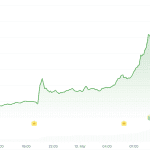

Bitcoin concluded the week above $70,000 after seven consecutive days of gains, marking its strongest streak since March. The cryptocurrency’s sustained momentum above critical support levels has analysts eyeing an ambitious $80,000 target, while key on-chain metrics suggest the market may be positioning for another significant rally.
Seven-Day Rally Breaks Above Critical Support Levels
Bitcoin’s impressive weekly performance delivered an 8% gain, pushing the cryptocurrency above two crucial long-term indicators. The price maintained its position above the 200-week exponential moving average at $68,300 and the previous 2021 all-time high near $69,400, both now serving as strong support levels.
Despite a brief Friday dip that likely represented profit-taking activity, Bitcoin quickly recovered and closed the week strong. This resilience above historically significant levels suggests institutional and retail confidence remains intact, setting the stage for potential further upside movement.
MVRV Z-Score Analysis Points to Accumulation Opportunity
The Market Value to Realized Value Z-Score currently sits at 0.469, well above the critical -0.262 threshold that historically marks major cycle lows. This metric compares Bitcoin’s market capitalization to its realized cap, effectively measuring whether the asset trades above or below fair value.
Historical data reveals three significant cycle bottoms when the MVRV Z-Score reached approximately -0.262 in 2015, 2019, and 2022. Following the 2022 low, Bitcoin surged 67% within three months before ultimately climbing over 1,000% to reach new highs. While current readings suggest potential for further downside before reaching optimal accumulation zones, the metric provides valuable context for long-term positioning.
Trading Range Dynamics and Key Price Levels
Bitcoin currently operates within a defined trading range between $54,400 and $78,400, with most price action occurring within these boundaries before major directional moves emerge. The cryptocurrency faces immediate resistance around $72,000, followed by a more significant barrier in the $75,000-$80,000 zone.
Key technical levels include:
- Resistance: $72,000 (short-term) and $75,000-$80,000 (extended target)
- Support: $69,400 (former resistance turned support) and $68,300 (200-week EMA)
This structure suggests Bitcoin needs to decisively break above $72,000 to target the upper resistance zone, while any weakness below $69,400 could signal a deeper correction toward the lower range boundary.
Market Catalysts and Federal Reserve Impact
The upcoming Federal Open Market Committee meeting on March 17-18 represents a potential catalyst for Bitcoin’s next major move. While futures markets indicate minimal expectations for rate cuts, monetary policy decisions often trigger significant volatility in risk assets including cryptocurrencies.
If Bitcoin maintains its position above $70,000 while on-chain metrics remain supportive, the path toward $80,000 becomes increasingly viable. However, any dovish surprises from the Fed could accelerate this timeline, while hawkish commentary might pressure the cryptocurrency back toward range lows.
Implications for Bitcoin Investors and Market Outlook
The current technical setup presents both opportunities and risks for Bitcoin investors. The seven-day winning streak demonstrates strong momentum, but historical patterns suggest caution as the cryptocurrency approaches key resistance levels where profit-taking typically intensifies.
For long-term investors, the MVRV Z-Score analysis indicates Bitcoin hasn’t yet reached optimal accumulation levels seen at previous cycle bottoms. This suggests patience may be rewarded with better entry opportunities, particularly if the metric approaches the -0.262 threshold that has historically marked major turning points.
Bitcoin’s ability to hold above $70,000 while targeting $80,000 represents a critical test of the current bull market’s sustainability. Success in breaking through upper resistance could signal the beginning of a more substantial rally phase, while failure might indicate the need for further consolidation before the next major upward move.