
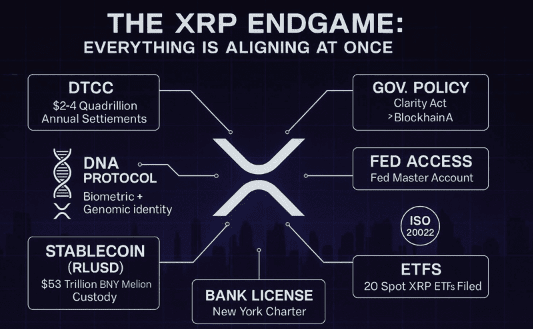
Ripple and the broader XRP ecosystem are back in the spotlight after a DTCC-linked patent filing renewed discussion about how blockchain networks could fit into future financial market infrastructure. The patent, published as US20250078162A1 on March 6, 2025, outlines a framework for managing digital liquidity tokens across distributed ledger systems and includes example routing between the Stellar network and a “Ripple DLT System.” It does not explicitly name XRP in the text visible on Google Patents, but it does describe cross-network settlement architecture that has drawn attention from crypto markets.
Patent highlights cross-ledger settlement design
The filing describes “digital liquidity tokens” as tools for connecting assets and markets across different networks, with the goal of improving liquidity and reducing friction in transfers between systems. In one example, the patent describes a transaction route that moves an ABC token from a user on a Stellar distributed ledger system to a user on a Ripple distributed ledger system, showing how a route-planning service could identify bridges across heterogeneous networks.
That matters because DTCC sits at the center of U.S. market plumbing. The patent itself is assigned to DTCC Digital (US) Inc., tying the document to a major financial-market infrastructure operator rather than a crypto-native startup. While the filing is a patent application rather than a live production rollout, it reinforces that tokenized settlement and cross-chain interoperability are being studied at the infrastructure level.
Hidden Road deepens Ripple’s institutional footprint
The broader Wall Street angle has grown stronger because of Ripple’s acquisition of prime broker Hidden Road. Ripple announced the $1.25 billion deal in April 2025, saying Hidden Road clears about $3 trillion annually across markets and serves more than 300 institutional customers. Ripple also said Hidden Road would migrate post-trade activity onto the XRP Ledger over time to streamline operations and reduce costs.
A DTCC notice published on February 27, 2026, also shows Hidden Road Partners CIV US LLC being added to the NSCC MPID directory effective March 2, 2026, under clearing broker PERS, number 0443, and executing broker code HRFI. That does not mean DTCC is settling trades on XRPL today, but it does show Hidden Road operating inside the same broader clearing environment used by traditional U.S. markets.
Why the market is paying attention
The combination of a DTCC-linked patent discussing Ripple DLT routing and Ripple’s move into institutional prime brokerage has fueled speculation that XRP-related infrastructure could gain relevance in tokenized finance. That said, the strongest verified takeaway is narrower than some social media claims suggest: the patent demonstrates interest in cross-ledger settlement design and explicitly references a Ripple DLT system, but it is not proof that DTCC has selected XRP as a production settlement asset.
For Ripple, however, the strategic picture is still significant. The company is no longer positioned only as an external blockchain vendor. Through Hidden Road, it now has a much closer link to institutional market structure, while the patent discussion adds to the narrative that interoperability, tokenization, and post-trade efficiency are becoming serious priorities for established financial players.
Ripple’s role in tokenization debate keeps growing
Tokenization remains one of the biggest themes in digital finance, with financial firms exploring how real-world assets, collateral, and post-trade workflows could move onto blockchain-based rails. In that context, any direct mention of Ripple DLT systems inside a DTCC-linked patent is enough to draw market attention, even if it stops short of confirming XRP adoption.
For now, the patent should be viewed as a signal of experimentation rather than a final roadmap. But taken together with Ripple’s Hidden Road acquisition and growing focus on institutional infrastructure, it strengthens the view that Ripple is pushing deeper into the core architecture of digital finance rather than remaining on the edge of it.